




by Sam Hawcroft and John Prince
Yorkshire Water has acknowledged that a storm overflow operated shortly before discoloured water was reported at Hornsea beach – but insists that sampling showed it was disturbed boulder clay rather than sewage.
The company addressed the controversy during a meeting of East Riding Council’s Environment and Regeneration Overview and Scrutiny Sub-Committee on Wednesday, September 2.
Yorkshire Water representative Adam Ashman told councillors that the company had investigated after being notified by the Environment Agency of a pollution report.
He confirmed that a storm overflow had operated in the period before the report was made, but said: “Sampling confirmed that actually the report was not related to sewage; it was brown water stirred up – boulder clay stirred up by wave action.
“So, all the results for Hornsea continue to be consistent with its previous performance, and we’re fully expecting it to continue being an excellent beach.”
The comments follow claims that frothy and dirty seawater which washed ashore on Sunday, August 23, was “raw untreated sewage”.
Tests were carried out by Yorkshire Water and the Environment Agency after a photograph was posted online claiming “filthy” sewage was washing ashore.
The organisations said no pollution was detected and that the discolouration was most likely a harmless natural occurrence caused by disturbed boulder clay or an algal bloom.
Hornsea resident David Rhodes, who had posted the photograph after receiving it from a third party, told the Gazette that the town operated on a combined sewer system, with rainwater run-off and wastewater from homes carried through the same network to the pumping station at Graingers Field.
Mr Rhodes said he understood that two underground tanks could store 1.4 million litres before the contents were pumped to Mappleton treatment works.
He said: “When it rains, the storage system at Hornsea is overwhelmed and the capacity at Mappleton is also unable to cope, leading to sewage releases.
“In all of this, I am simply trying to stop the releases, which are harming our environment. I’m not a scientist, and all the information I have gleaned has been from people in the area and ex-Yorkshire Water employees.
“The incident last weekend was found not to be sewage, but the event that led me to that conclusion was that they released for 55 minutes the week before.
“As it turned out, it wasn’t sewage, but at least it got Yorkshire Water down immediately and they checked and found the sea to be safe on a very busy weekend, so just for that reason publishing the picture online was vindicated.
“As for the accusation of scaremongering, if Yorkshire Water hadn’t released 6.5 million litres of sewage into the sea in the three days previous, I wouldn’t have been as concerned, but they had, and that needs pointing out to people.”
Mr Rhodes also called for the Environment Agency to take regular samples at the north end of the beach near Morrow Avenue and at the south end near the boat ramp, as well as at the existing designated bathing-water sampling point.
He said this would provide a wider picture of water quality and how any discharge was affected by tides, currents and wind.
Mr Rhodes said: “I use Floodmapper UK for details of sewage releases. They aggregate the releases against Yorkshire Water’s own maps, which only show the last release.
“Often the releases are very short-lived – around four minutes is very common – but in that short time they can pump half a million litres of sewage, so it’s easier to collate the releases. Floodmapper are generally reliable as an accessible aggregator of public environment data.”
Asked by the Gazette to respond to Mr Rhodes’ claims, a Yorkshire Water spokeswoman explained that combined storm overflows (CSOs) acted as relief valves when the sewer network was over capacity.
She said the combined network carried wastewater from homes and businesses, as well as surface water and rainfall, and could discharge during heavy rain to prevent the system backing up into properties and streets.
“As such, these discharges do include untreated wastewater, albeit heavily diluted by rain,” she said. “Discharges are permitted by the EA under these circumstances.”
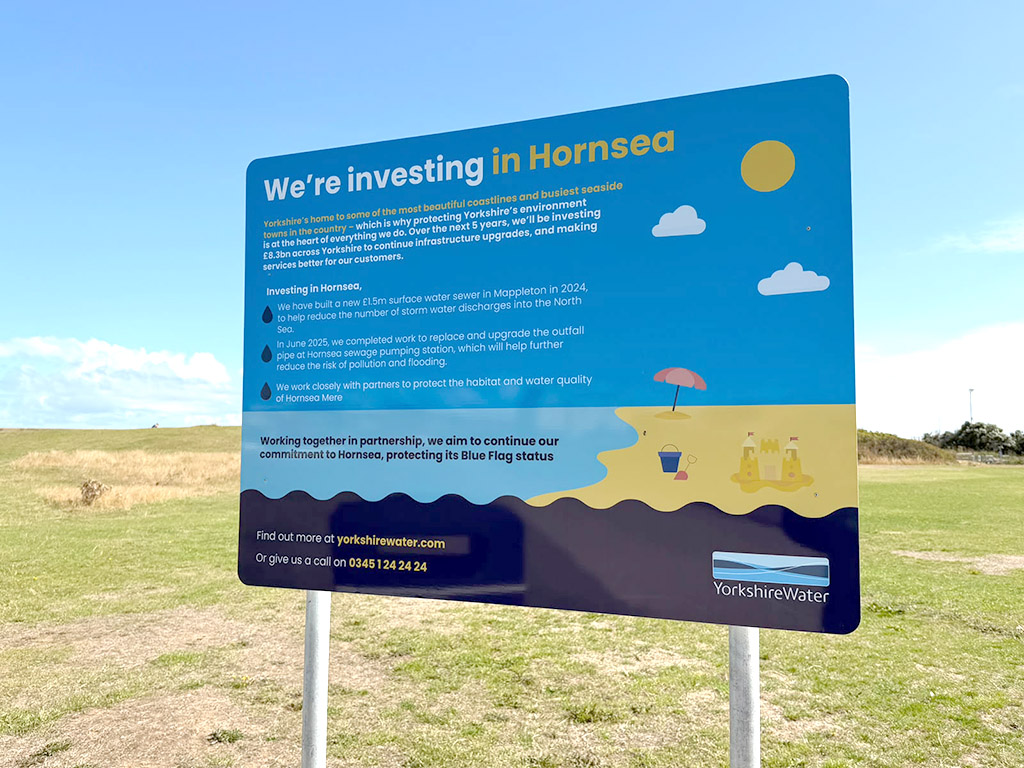
Yorkshire Water said it was investing £1.5 billion between 2025 and 2030 in upgrading CSOs across the region, following investment of £180 million during the previous two years.
The spokeswoman said: “Our CSOs are operating more than we, and our customers, would like.
“We’re seeing the results of this investment already. In 2025, we reduced the number of discharges into watercourses by 24.5 per cent, following on from a 12 per cent reduction in 2024.”
Under the Environment Act 2021, overflows within 1km of a bathing-water sampling point must be reduced to fewer than two discharges during a bathing season by 2035.
The spokeswoman said: “For investment in the current delivery period, 2025-2030, we need to prioritise beaches where bathing-water quality is poorer, and bathing-water quality at Hornsea has been assessed as Excellent for a sustained period.”
Yorkshire Water disputed Mr Rhodes’ claims that 6.5 million litres of sewage had been discharged in the days before the photograph was published and that half a million litres could be released in four minutes.
The spokeswoman said: “Water companies are only required to monitor and report on the frequency and duration of discharges, not the volume, so these figures have certainly not come from us. Discharges have different volumes – some could be high flow; some could be a trickle.
“Even should there have been that volume, the vast majority would be rainwater and surface water, not wastewater, so it would not be accurate to say ‘6.5 million litres of sewage’.”
The company said Hornsea’s pumping station passed forward 78 litres of combined wastewater per second to the treatment works.
It added that the location of the single bathing-water sampling point was a regulatory matter for the Environment Agency to reassess with the local authority if it was believed to be unsuitable.
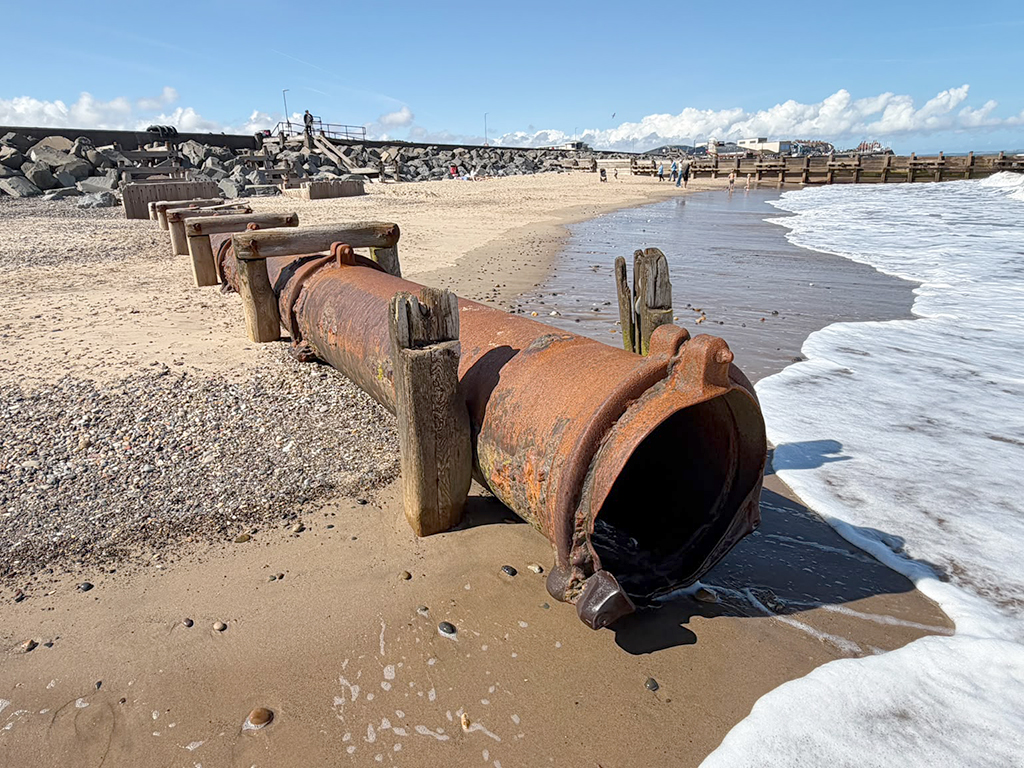
“The long sea outfall is 505m offshore,” the spokeswoman said. “David is correct that any discharge would be affected by tides, currents and winds, but the outfalls are designed to allow flows to be dispersed and diluted into the North Sea.”
Yorkshire Water pointed residents to its Event Duration Monitoring Map for almost real-time discharge information, generally with a delay of about 15 minutes, and recommended the Environment Agency’s Swimfo service for the latest sampling data.
The spokeswoman said: “It is also important to note that CSO discharges are not the only things that could impact coastal waters – agricultural run-off, private misconnections, industry, etc. all have a role to play in water quality.”
She added: “We are absolutely still committed to having a meeting with David Rhodes; this just needs to be organised.”
The wider performance of storm overflows was challenged during Wednesday’s scrutiny meeting.
Cllr Phillip Redshaw said his analysis of Environment Agency data showed that the number of incidents across the East Riding fell by 34 per cent in 2025 compared with 2024, while discharge hours fell by 52 per cent.
However, compared with 2021, he said incidents had fallen by 27 per cent but the total duration had reduced by only 6.5 per cent, from 30,493 hours to 28,528 hours, despite rainfall being eight per cent lower.
He said five sites had each discharged for more than 1,000 hours during 2025 and accounted for 23 per cent of all discharge hours.
Cllr Redshaw questioned why targets concentrated on the number of incidents rather than how long discharges lasted.
Mr Ashman said: “You’re right about the target being focused on the number of incidents. We do also look at the duration of incidents, but the target is very much on the number of incidents, and that’s how the funding mechanism has been created.
“The issue specifically that we’ve seen and impacts in East Riding is the groundwater-induced storm overflows.
“Where we’ve seen prolonged and heavy rainfall, and then we get significant ingress into the system, that is proving much more challenging.”
Yorkshire Water agreed to examine Cllr Redshaw’s figures and discuss the performance of individual sites with him. No Hornsea sites were identified during that exchange.
Mr Ashman added that existing monitors showed when an overflow was operating, rather than the volume discharged.
He said: “We’re trying to work out a way of converting the head data into a volumetric, which I think is the ultimate ambition of how much of the effluent has been lost.”