




by John Prince
The fight to eradicate polio once-and-for-all around the world was brought into focus as Rotarians held a coffee afternoon in Hornsea to raise awareness of a disease that once devastated families across the UK.
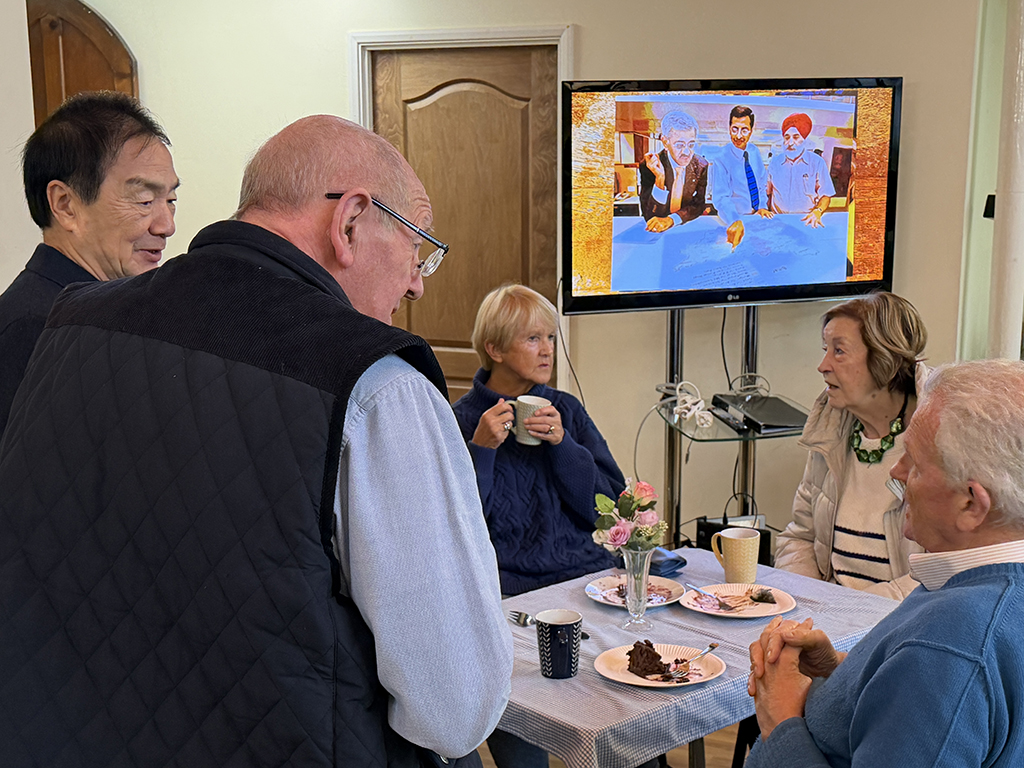
Members of the Rotary Club of Hornsea and East Riding welcomed visitors to the town’s Methodist Church as part of the international End Polio Now campaign.
A screen showed an information video about the disease, and a raffle was held to raise funds.
Rotary Club president Maung, who is a retired GP, explained why the campaign was still needed.
Polio mainly affects children under five and, in severe cases, can damage the nervous system, causing permanent paralysis or even death.
Maung recalled the devastating consequences before effective vaccines became available, including the use of iron lungs and tracheostomies to help patients whose breathing muscles had been paralysed.
“Most of the time, the children would be left lame and not able to breathe,” he said.
“In the early part of the last century, we were seeing a lot of patients who had suffered and didn’t have any treatment whatsoever.”
He described how vaccines developed by Jonas Salk and Albert Sabin transformed the battle against the virus. Salk’s injectable vaccine arrived in the 1950s, followed by Sabin’s oral vaccine, often given on a sugar lump.

For older people in Holderness, that method may bring back memories of a major local public health emergency.
During a major polio outbreak in Hull in 1961, remarkably more than 350,000 people received oral vaccinations in a week. More than 50,000 of those had travelled into the city from surrounding areas.
The campaign reached 96 per cent of Hull’s population.
A Ministry of Health report at the time recorded one non-paralytic case in Withernsea and three cases in neighbouring parishes, so the vaccination programme was extended. Some 5,000 people received the vaccine in just three days.
The last case of wild polio contracted in the UK was recorded in 1984, and Britain was declared polio-free in 2003. However, vaccination continues to be given out because the virus has not been eradicated worldwide.
In 1988, polio was still endemic in more than 125 countries. Since the launch of the global eradication campaign that year, cases of wild poliovirus have fallen by more than 99 per cent.
Afghanistan and Pakistan are now the only two countries where the disease remains endemic.
According to the Pan American Health Organisation, 48 cases of wild polio had been reported worldwide in 2026. Forty-two were in Afghanistan and six in Pakistan.
Maung said the greatest difficulty was not the effectiveness of the vaccine but getting it to children in remote and unstable regions.
“It’s not because the vaccine doesn’t work, but it’s the vaccine delivery that is the problem.
“As you can imagine in western Pakistan and certain parts of Afghanistan, the communication and transport in these areas are limited.”
He highlighted war, political upheaval and natural disasters as obstacles to vaccination teams, alongside the practical difficulties of transporting vaccines.
Vaccines must be kept at carefully controlled temperatures to maintain their effectiveness. Specialist insulated cool boxes and cold packs allow doses to be transported to remote communities, even where conventional refrigeration is unavailable.
Maung explained how oral vaccines, administered as drops rather than injections, could reach children in isolated areas.
“In rural areas of developing countries, they have a larger chance of taking the vaccine from the vaccine centre to the periphery of whatever health centres they’ve got, or even homes and villages. These drops can be put in the mouths of these youngsters,” he said.
Rotary International has played a major role in polio eradication, contributing more than $2.9 billion and helping protect more than three billion children in 122 countries.
Maung hoped the final remaining pockets of wild polio could be eliminated within the next decade, although substantial challenges remained.
The Hornsea afternoon followed World Polio Day and reminded visitors that although polio has disappeared from everyday life in our country, the work to eradicate it worldwide is far from finished.
A video is available here: tinyurl.com/y5w9batz