

by Gazette Reporter
More than half of people who have responded to a recent survey into mobile phone coverage across Holderness have rated their local mobile service as three out of ten or worse.
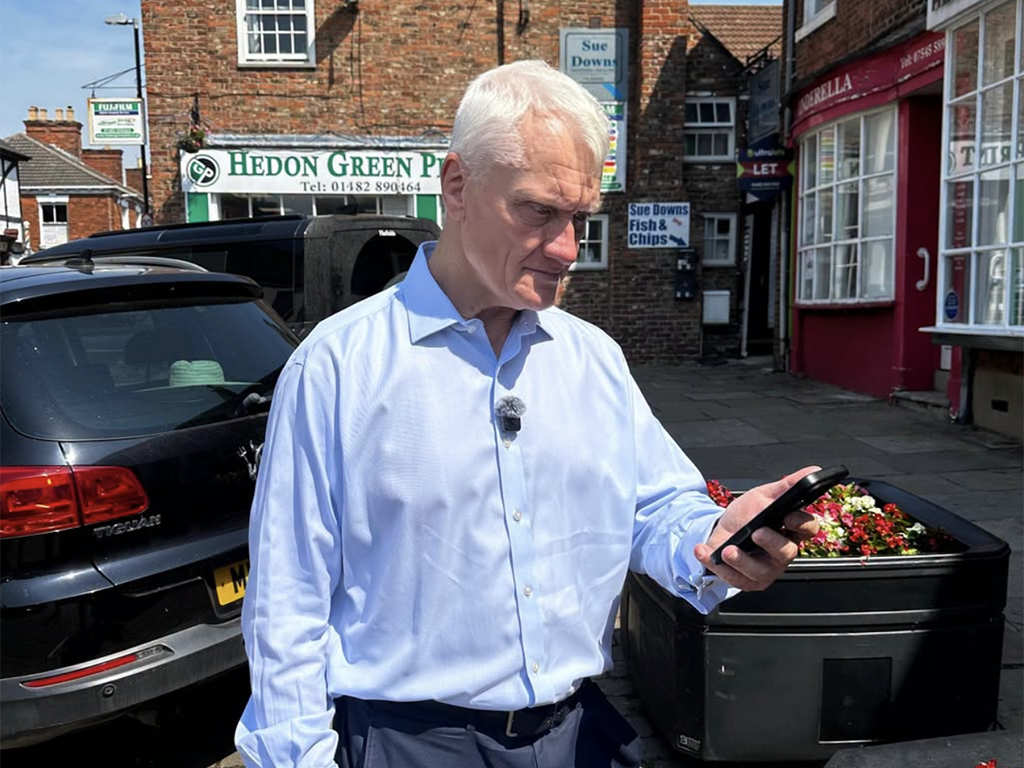
Beverley and Holderness MP Graham Stuart has been gathering evidence from residents as part of his campaign to understand why mobile phones are failing people, and what needs to be done to fix it.
There have now been 100 survey responses from the Mid Holderness, North Holderness, South East Holderness, South West Holderness and East Wolds and Coastal wards.
The average rating for mobile coverage in respondents’ local areas was just 3.46 out of ten, with 54 people rating it between one and three.
Unlike in Beverley, where many residents report their phones displaying 4G or 5G but being unable to use it, the evidence from parts of Holderness includes a more fundamental problem: people struggling to get a reliable signal at all.
Aldbrough has been one of the clearest examples.
Mr Stuart previously gathered evidence from residents in the village and took it directly to Three, which acknowledged there was a problem with its local service.
Residents said they were reliant on Wi-Fi calling in their homes, while one said people on some networks had to walk out of the village towards the cemetery to make a mobile phone call.
There were also concerns about what happens during power cuts, when residents can lose their broadband connection and therefore the Wi-Fi calling on which they depend.
The latest survey shows poor service is not confined to Aldbrough.
Residents have reported problems from communities across Holderness, while Facebook comments to Mr Stuart include reports of little or no signal in Long Riston, Burstwick, Preston and Hornsea.
The MP is continuing to gather evidence rather than assuming the same problem or solution applies everywhere.
He has raised mobile service directly with EE and O2 and is arranging discussions with VodafoneThree.
His next step is to get network engineers onto the ground in Beverley and Hedon, while continuing to build the evidence from villages across Holderness so the networks can be challenged on what is needed to improve rural coverage too.
Graham Stuart said: “You shouldn’t have to leave your village to make a phone call, yet that is what people in parts of Holderness are telling me they have to do.
“We’ve already seen it in Aldbrough. People were telling me they couldn’t get a reliable mobile signal, so I took their evidence to Three and Three who acknowledged there was a problem.
“Now the wider survey is giving us a much clearer picture. We have 100 responses from across the Holderness wards and more than half rate their local coverage at three out of ten or worse.
“I’m not going to pretend the problem is identical everywhere because it plainly isn’t.
“In Beverley you can have 4G or 5G showing on your phone and still find that nothing works. In some Holderness villages the problem is much more basic: getting a reliable signal in the first place.
“That can be an inconvenience, but it can be much more serious than that. If your mobile only works through your home broadband and there’s a power cut, how are you supposed to contact someone when you need help?
“So I’m still listening. I want people across Holderness to keep telling me where their phone doesn’t work, which network they’re with and exactly what happens.
“Then we can put that evidence in front of the networks, establish what each area actually needs and push them to deliver it.
“People pay for a mobile service. They should be able to use it.”
Residents can report their mobile experience by completing the survey at grahamstuart.com/mobile2026