



by John Prince
Before I even get stuck into a nice Chianti and some fava beans, I’ll get this out of the way…
Bringing to the stage one of the most influential serial killer stories of the past 40 years – and a film that helped inspire a whole generation of psychological thrillers – is one heck of a tough ask.
Jonathan Demme’s 1991 film swept the Oscars, winning five Academy Awards, including best picture, best actor and best actress for Hollywood heavyweights Sir Anthony Hopkins and Jodie Foster. It boasted an iron-clad supporting cast and even a cameo from ‘Wicked Game’ singer Chris Isaak (which is always a joy in a horror film…).
But I’m going to put all that on a side plate for now, because anyone expecting a theatrical re-enactment of that cinematic masterpiece is likely to go away with a raised eyebrow.
And that would be a shame, because there is plenty here to admire and get your knife and fork into.
This is a stage adaptation of Thomas Harris’s novel, not a carbon copy of the film, and it deserves to be judged on those terms.
Any actor, whether on stage or screen, would find Hopkins’s portrayal of Hannibal Lecter a tough act to follow – and perhaps a particularly chewy one at that.
His chilling, almost reptilian performance has become so firmly embedded in popular culture that it is difficult to imagine anyone else inhabiting the role.
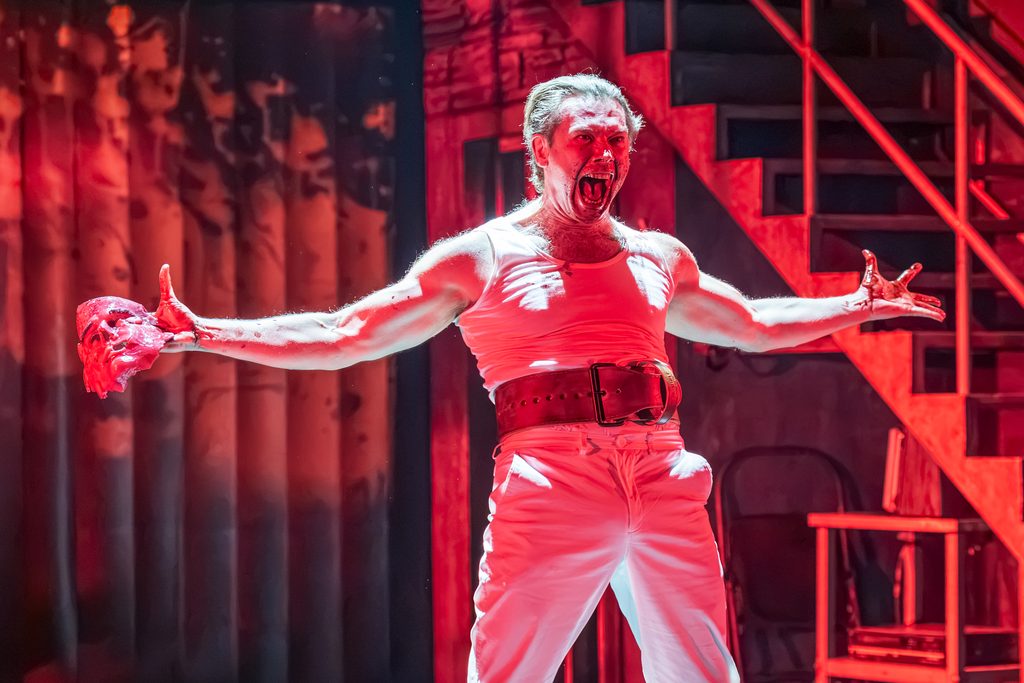
But John Partridge, taking on the infamous cannibalistic psychiatrist in this new production, wisely avoids attempting a direct impersonation.
Partridge’s Lecter (above) is altogether more animated than Hopkins’s unnervingly still creation. Where the film’s Hannibal could hold an audience captive with the slightest movement of his eyes, this Lecter prowls, leans, gestures and uses his entire body to unsettling effect.
Hopkins reportedly studied reptiles in developing his performance, and the result was a character almost lizard-like in his stillness, apparently relaxed but always ready to pounce.
Partridge’s interpretation is more openly expressive and physical, sometimes almost charming, but with that same underlying sense of danger.
He is charismatic, commanding and, dare I say, rather handsome in the role, bringing a flamboyance to a character whose menace on screen was largely built around what he didn’t do.
It is a different interpretation rather than an inferior imitation, and I rather liked it. And he does have very nice teeth.
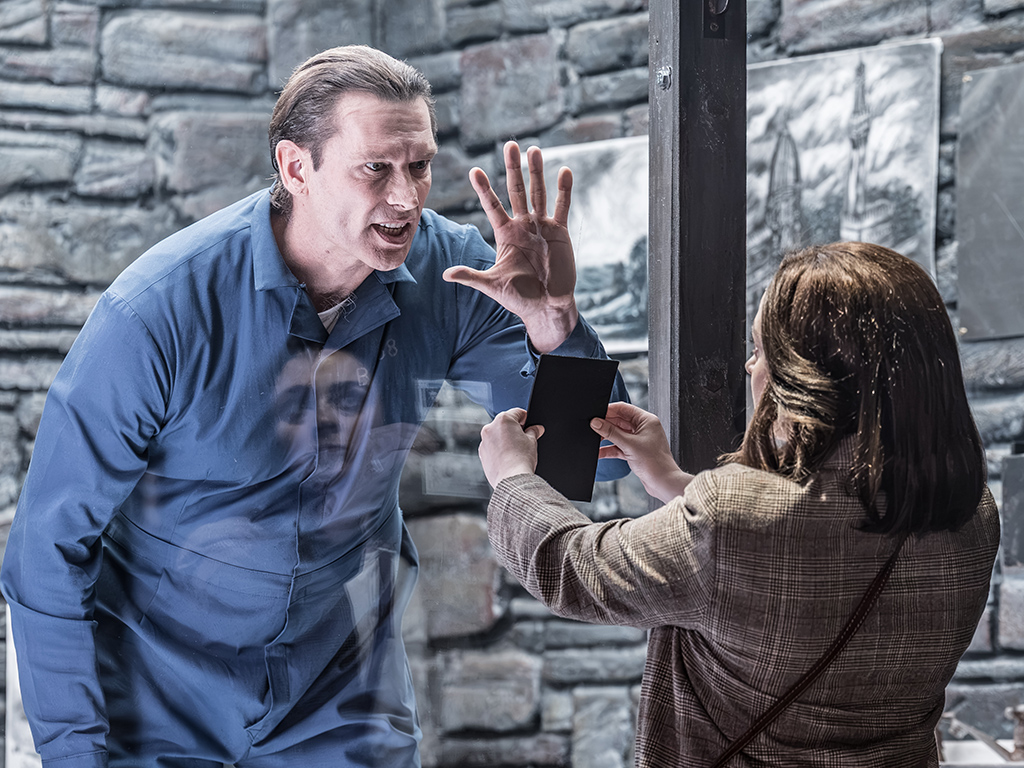
If you’ve somehow managed to avoid The Silence of the Lambs for the past 35 years, the story follows ambitious young FBI trainee Clarice Starling, played here by Mollie Gallagher, who is sent to interview the imprisoned Lecter in the hope of gaining information that might help catch another serial killer, Buffalo Bill.
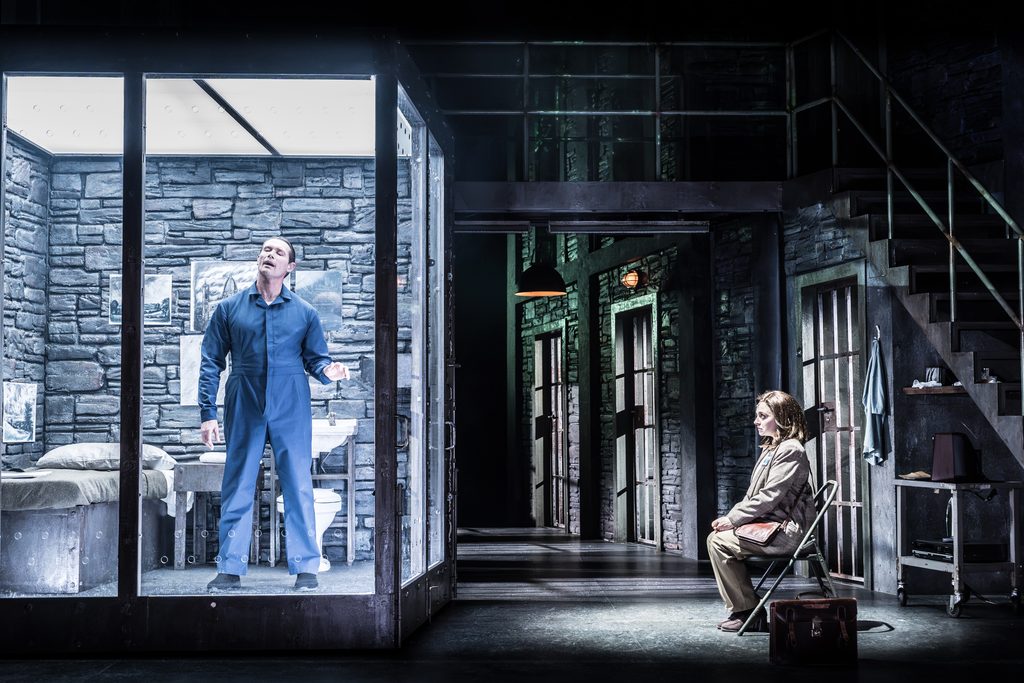
Gallagher brings a stiffness and vulnerability to Starling beneath her determination to prove herself in the male-dominated world of the FBI.
Her relationship with Lecter remains the heart of the story, although recreating the extraordinary intensity of the Hopkins and Foster encounters is an almost impossible task.
On film, the camera takes us uncomfortably close, placing us directly in the path of Lecter’s penetrating stare. We can see every tiny movement, every flicker of expression, every minute suggestion of what might be going on behind the eyes.
In a theatre, particularly one the size of Hull New Theatre, that intimacy is inevitably diminished. Those wonderfully subtle facial expressions simply cannot carry to the back of the auditorium.
But theatre has other ways of getting under the skin, and director Nikolai Foster makes effective use of them.
The staging is one of the production’s strongest features. Indeed, the set almost becomes another character in its own right, with Lecter’s giant imposing mobile cell proving a particular highlight.
As it moves further towards the centre of the stage, it commands more and more of the space, a clever visual representation of how Lecter dominates proceedings even while incarcerated.
It is a striking piece of theatre, and one of the elements I suspect many in the audience had been particularly keen to see.
The physical performances, lighting and movement around the stage all help create an atmosphere of unease, and there are some genuinely startling moments, including sudden, violent blows against the glass that certainly made me jump.
A translucent screen across the front of the stage provided another clever visual touch, with projections of falling rain, bloodstains and butterflies adding to the brooding atmosphere without interrupting the action.
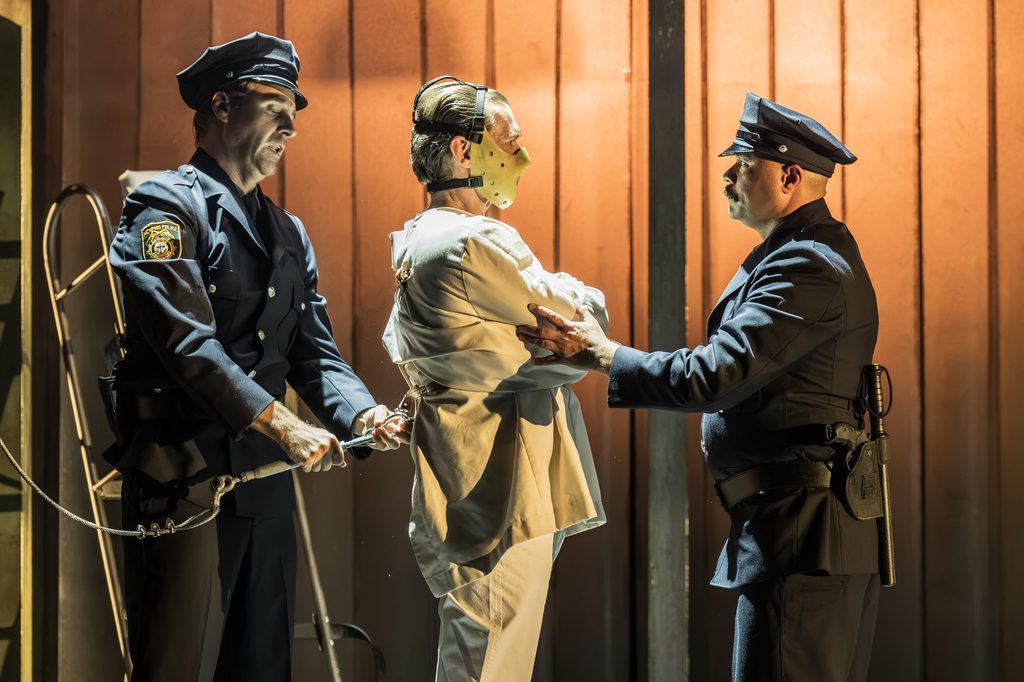
Oliver Farnworth plays FBI agent Jack Crawford, although his interpretation is less measured than Scott Glenn’s screen portrayal, while Sam Jackson’s Buffalo Bill takes the character in a decidedly grotesque direction.
For me, Jackson’s Buffalo Bill was suitably unhinged, although there were moments when his increasingly bizarre antics threatened to undermine the genuine menace of the terrifying figure portrayed by Ted Levine in the film.
Nevertheless, Jackson throws himself into the role with an unsettling physicality and considerable state of undress, while the character’s gruesome ambition to create a suit from human skin remains as deeply disturbing as ever.
There are some notable differences in the way familiar scenes are presented, too, and moments that film audiences might expect simply do not materialise in quite the same way. But this is theatre and it doesn’t have the luxury of multi-camera shoots, different locations and slick editing.
At times, the production is heavily reliant on dialogue, necessarily so when attempting to unravel the psychological complexities of Harris’s story on stage.
But the cast handles this well, and there is enough movement, tension and, certainly, visual interest to keep things building.
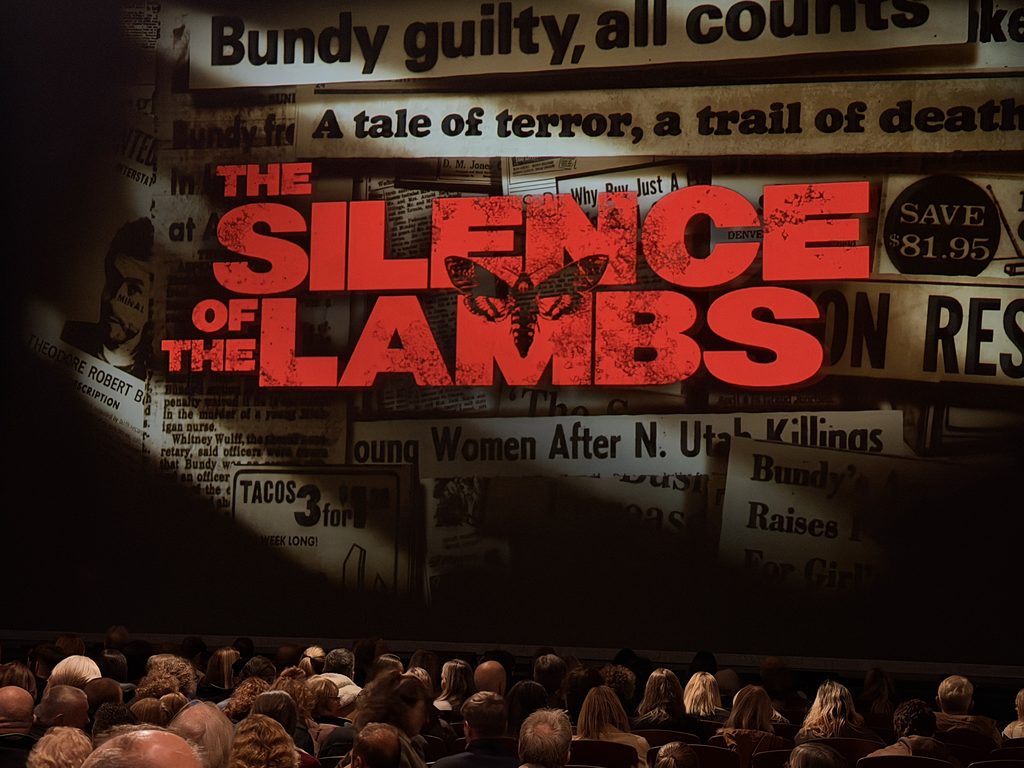
Perhaps the greatest difficulty facing any production of The Silence of the Lambs is that the film has become so iconic that we instinctively – and unfairly – compare everything against it. Every character, every encounter and every chilling line comes with an expectation.
And yet this adaptation, written by Gina Gionfriddo, has its roots in the novel rather than Jonathan Demme’s interpretation of it. Once you accept that, there is a great deal to enjoy and to shock.
Partridge deserves particular credit for making Lecter his own, while Gallagher provides a convincing counterbalance as Starling.
It may not possess quite the same suffocating and nightmarish psychological intensity as the film, but it offers something different – an engaging, visually impressive and occasionally shocking theatrical interpretation of a familiar story.
I liked the film, I liked the book and I liked this. They are three different beasts, and there is room for all.
Even if – spoiler alert – that famous line about the Chianti and fava beans doesn’t get uttered once.
The Silence of the Lambs runs at Hull New Theatre until Saturday, November 7.