

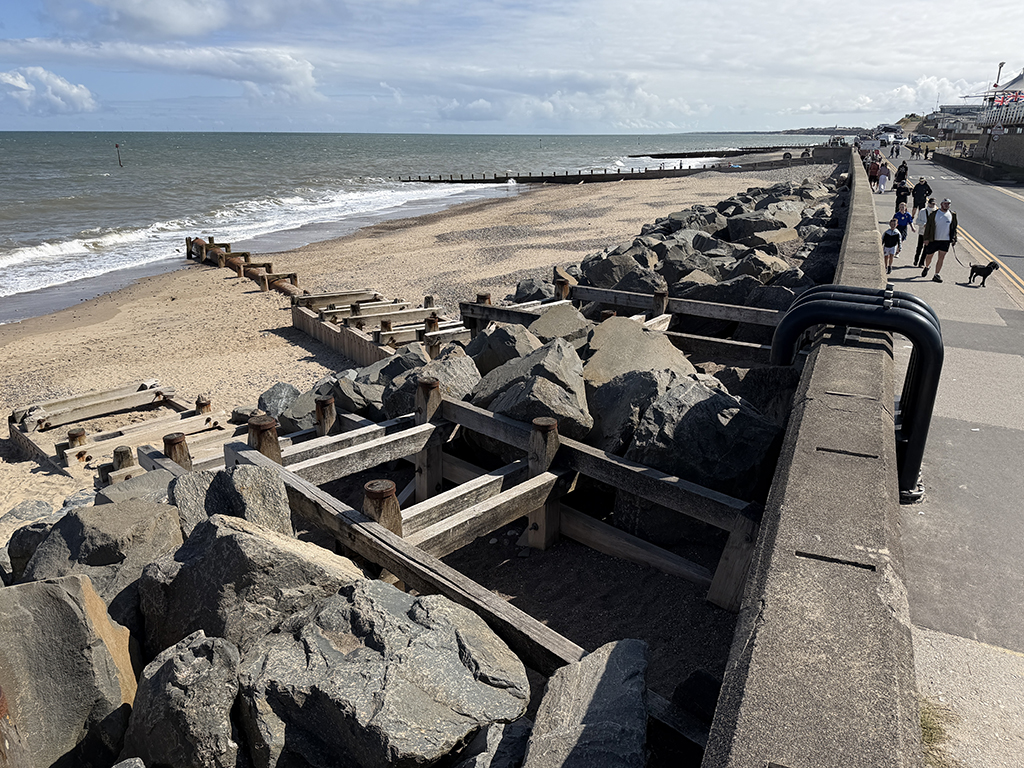
Unsubstantiated claims that sewage is washing up on Hornsea beach are damaging the town’s economy and putting tourists off visiting the resort, councillors have warned.
At the latest meeting of Hornsea Town Council, East Riding councillor Barbara Jefferson condemned photographs and claims circulating widely on social media that brown water and foam seen along the shoreline were evidence of sewage – despite both Yorkshire Water and the Environment Agency investigating and finding no signs of pollution.
She said the publicity had already had a tangible economic impact, revealing that a family had cancelled a bank holiday Airbnb booking in the town because of what they had read.
Cllr Jefferson said: “This weekend has been traumatic because misinformation on social media yet again, regarding raw sewage in photographs, has spread far and wide and has caused much controversy to the detriment of this town and potentially our local businesses.
“A local resident who owns an Airbnb contacted me yesterday, saying a family who had booked for the bank holiday weekend had cancelled due to the adverse publicity.
“I obviously apologised, which is all I could do, and explained that I was waiting for evidence from Yorkshire Water and the Environment Agency, both of whom I had contacted.”
Cllr Jefferson then read councillors the detailed response she had received from Yorkshire Water shortly before today’s meeting.
It confirmed that both Yorkshire Water and the Environment Agency had investigated the reports on Sunday, August 23, with no pollution found.
Yorkshire Water said it had received a pollution report from the Environment Agency at about 9am after a member of the public reported seeing discolouration on the beach at about 2pm on Saturday, August 22. The same person returned on Sunday morning and said the water remained discoloured.
A Yorkshire Water field investigation team was sent to Hornsea and arrived at about 1pm.
Its statement, read to the meeting by Cllr Jefferson, said: “At 1pm on Sunday, August 23, one of our field investigation teams arrived on site and checked our local surface water outfalls and storm outfalls, with no obvious visible signs of rags or debris.
“Subsequently, they took a spot sample in the location reported, which recorded an ammonia result indicating that no ammonia was present which is associated with sewage pollution.
“Our field operations technician provided feedback via our duty operations engineer to the Environment Agency at 3.30pm that afternoon and confirmed that no pollution was found.”
The company also openly confirmed that storm overflow discharges had taken place at Hornsea during the preceding week.
It said: “We do have a combined storm overflow in Hornsea and it had three short-duration discharges last week on August 19, 20 and 21.
“All three of these discharges were identified as consented discharges driven by the high rainfall.
“We are not aware of any operational failures or problems with any Yorkshire Water assets in the locality.”
Yorkshire Water’s live overflow data showed a discharge on Friday, August 21, lasted four minutes, from 2.49pm to 2.53pm.
Councillors stressed that acknowledging those discharges was important, but said their occurrence did not prove that material photographed on the beach during the following weekend was sewage.
Yorkshire Water said the most likely explanation for the brown appearance of the sea was the geology beneath Hornsea and the rough conditions experienced along the coast.
Its statement continued: “With regards to the discolouration seen at the beach, Hornsea sits on top of boulder clay. Strong wave action can disturb the seabed and uplift some of this clay sediment, making the water appear brown.
“There was also a large swell on the North East coast at the end of last week. It’s very possible this contributed to the brown colouring of the sea.
“There are many natural causes of discoloured water on the east coast and we think, in this instance, the discolouration was caused by a natural event rather than sewage pollution.
“The ammonia reading of 0.0 mg/l would support this assertion.”
Boulder clay is a fine glacial sediment found extensively beneath the Holderness coast. When the seabed is churned up by strong waves and a large swell, very fine particles can become suspended in the water, producing the muddy or brown appearance seen close to shore.
Foam can have a separate natural explanation. Organic material and marine algae can be whipped up by waves into creamy or brownish foam, particularly during rough weather and as algal blooms break down.
The Environment Agency has previously warned that this is commonly mistaken for sewage around the British coast.
It said: “Every year we receive many reports of suspected sewage pollution at coastal waters in particular that are in fact the breakdown of algal blooms.
“It’s easy to mistake algae for sewage, particularly as both have an unpleasant smell, but if you notice foam on the water’s surface or on the beach it’s more likely to be the result of an algal bloom breaking down.”
The agency says blooms of Phaeocystis, a common non-toxic marine algae, can form during warmer, sunnier conditions before breaking down and creating creamy-brown foam. In rough seas this can accumulate in lines or thick patches along the shoreline and can give off an unpleasant smell.
Deputy mayor Cllr Nick Cox also challenged the way information about storm overflows was being interpreted and circulated.
He said some information acquired by local campaigners came from the marine conservation charity Surfers Against Sewage, but argued that it could not guarantee its information was accurate.
“People don’t believe the Environment Agency, people don’t believe Yorkshire Water – but I say, they can’t lie.”
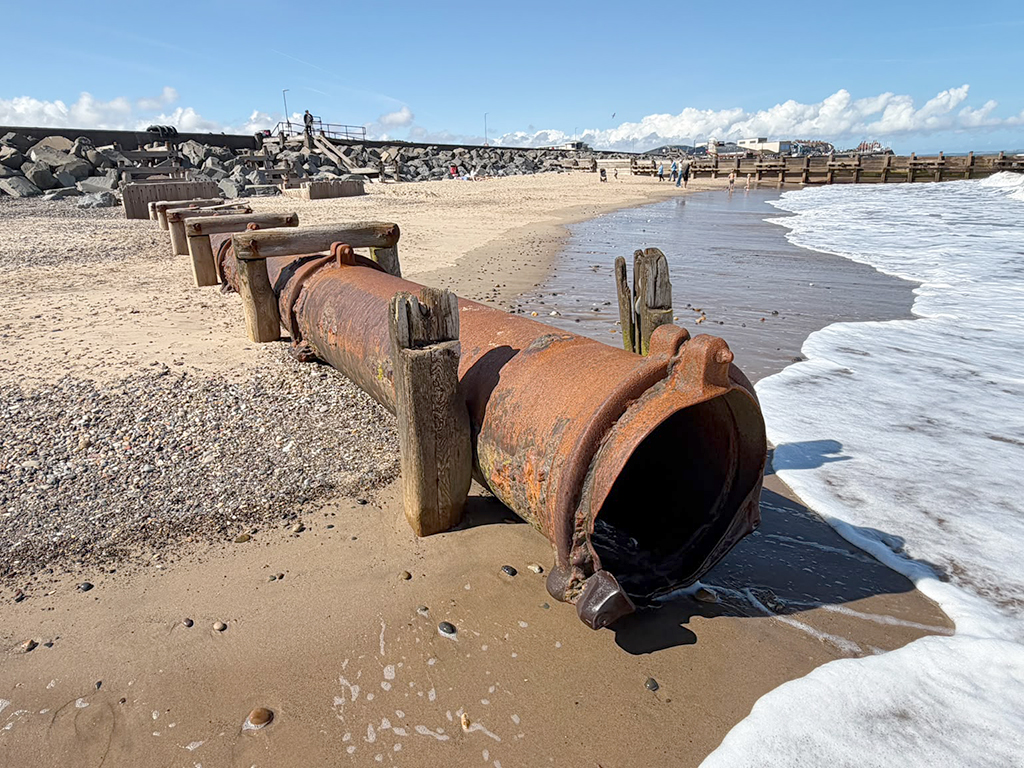
Hornsea’s wastewater system has itself sometimes been confused with the much shorter pipe visible across the beach, pictured above. That pipe is a 143-metre surface-water drain carrying rainwater and natural runoff from Hornsea Mere beyond the tide line.
The town’s wastewater and storm system uses separate infrastructure, including an outfall pipe well beneath the seabed, extending about 1km offshore.
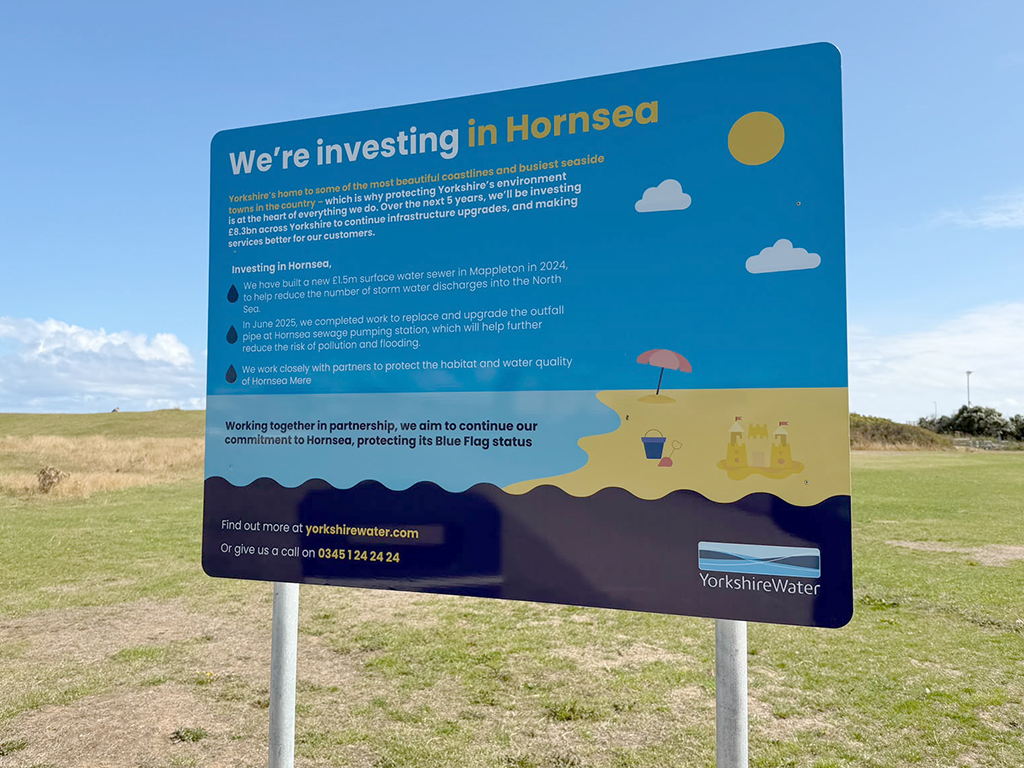
Yorkshire Water has acknowledged that storm overflows remain an environmental issue and says it is investing to reduce their operation. It has previously said £1.5 million of essential capital maintenance was carried out on Hornsea’s combined sewer overflow in 2025, including replacement of an outfall pipe intended to prevent seawater entering the system and triggering premature discharges.
Hornsea also retained its Blue Flag status in 2026 for the sixth consecutive year. The internationally recognised award includes bathing water quality among its criteria alongside beach cleanliness, safety, environmental management and facilities.
Councillors said people should continue to report anything they believed could be pollution so that it could be properly investigated.
The Gazette has contacted the individual who made some of the originally reported claims for further comment.