



by John Prince
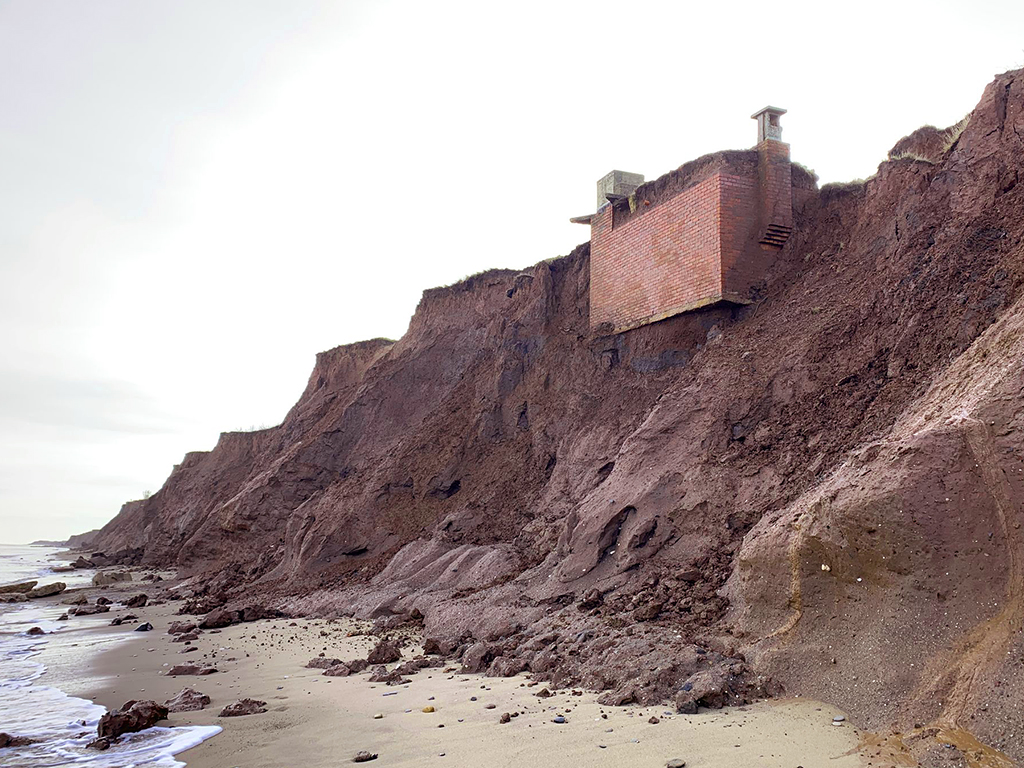
An old nuclear monitoring post in East Yorkshire is in danger of falling out of a cliff face in to the sea, sparking safety fears.
The once-hidden structure at Tunstall beach between Withernsea and Hornsea has been there for around 70 years.
Built in the late 1950s, the former Cold War-era lookout station has become exposed over the years because of severe coastal erosion, and is jutting out precariously above the sand and rocks below.
Commissioned and operated by the Royal Observer Corps (ROC), it formed part of the UK’s Cold War civil defence network, and was used for nuclear blast detection and radiation monitoring.
Two small chambers were built underground which were intended for short-term occupancy, usually by volunteers.
It was decommissioned in the early 1990s.
When it was first completed, the brick structure was around 100 yards inland from the shoreline.
But following decades of coastal erosion along the east coast, it’s now hanging out of the cliff about 25 feet above the beach, which is used by the public.
It’s only a matter of time before the cliff below it gives way. It’s estimated that the station, which is made from brick and reinforced concrete, could weigh anything between 30 to 40 tonnes.
Access to the beach is difficult, but it is regularly used by fishermen who have made their own makeshift steps in the cliffs in order to get down to it.
One of the fishermen, Mark Green, 53, said he’s worried that the bunker poses a danger to people who are walking underneath or near it when it falls.
He said: “This year the erosion has been especially bad. I come round here fishing, and it’s all up and down this coast.
“Getting down the cliffs to fish is getting worse and worse. We all dig steps ourselves. It’s like taking your life into your own hands, it’s so steep.
“That thing is going to go. We use them as markers so we know where we are. There are lots of them around here – at least there used to be.
“It’s getting so dangerous now for the lads on the beach fishing.
“There are holiday parks around here as well. If they can get down to the beach, people come wondering up to it. If that thing comes down and they’re close, they won’t stand a chance.
“It’s a shame as it’s part of our heritage, but it does need to be taken down. If it survives until the summer you still have big seas then, and it can come down at any time.”
The building, which is a stone’s throw away from the Sand le Mere holiday park and the village of Tunstall, has pulled some of the path away on the cliff top used by walkers, and has started to lean out slightly.
There are no plans in place to make the structure safe or remove it before it falls, leaving it open to the elements before its inevitable demise.
In a statement East Riding Council said: “Recognising the risk posed by the structure, the council would ask that people avoid the area, both at the cliff top and at the beach as it descends the cliff.
“The council would also remind visitors and residents to always maintain a safe distance to the base of eroding cliffs, due to the risks associated.

“East Riding Council does not have any statutory responsibilities connected to the structure. The structure sits on an area of privately owned land.
“This location lies within Policy Unit E (Rolston to Waxholme) of the Shoreline Management Plan. The approach for this location remains at ‘no active intervention’.
“Therefore, the coast is undefended in this area, which allows coastal processes to continue.
“The Ministry of Defence originally requisitioned the land to build the structure.
“But following its closure, the land was returned to the landowner. which included any military infrastructure upon it.
“The responsibility for this infrastructure therefore belongs to the landowner, and the management responsibility for the rural beach in this area sits with the Crown Estate.”
When is a bunker not a bunker?
A Cold War monitoring post like the one at Tunstall is often described as a nuclear bunker, but the two are different in terms of use.
In practical terms, the post was a small underground observation station, built for the ROC to measure blast pressure and radiation in the event of a nuclear strike.
It was never designed for long‑term survival.
There were no blast doors, no reinforced chambers, no air‑filtration systems, no power supply, and barely enough room for three volunteers to work for short periods. In common language, it was a monitoring point, not a shelter.
The confusion is understandable. To the casual eye, the site looks bunker‑like. It has a hatch, a ladder, a buried chamber and a Cold War back story.
As erosion exposes the structure, its brick and concrete shell and underground layout can easily be misread as a protective refuge. Anything underground and Cold War‑related is often labelled a “bunker,” even when the reality is far more prosaic.
The Tunstall post was a functional piece of civil defence infrastructure, built to gather information, not save lives.
Its purpose was measurement, not protection, and that is revealing itself as the building re‑emerges from the cliff.